
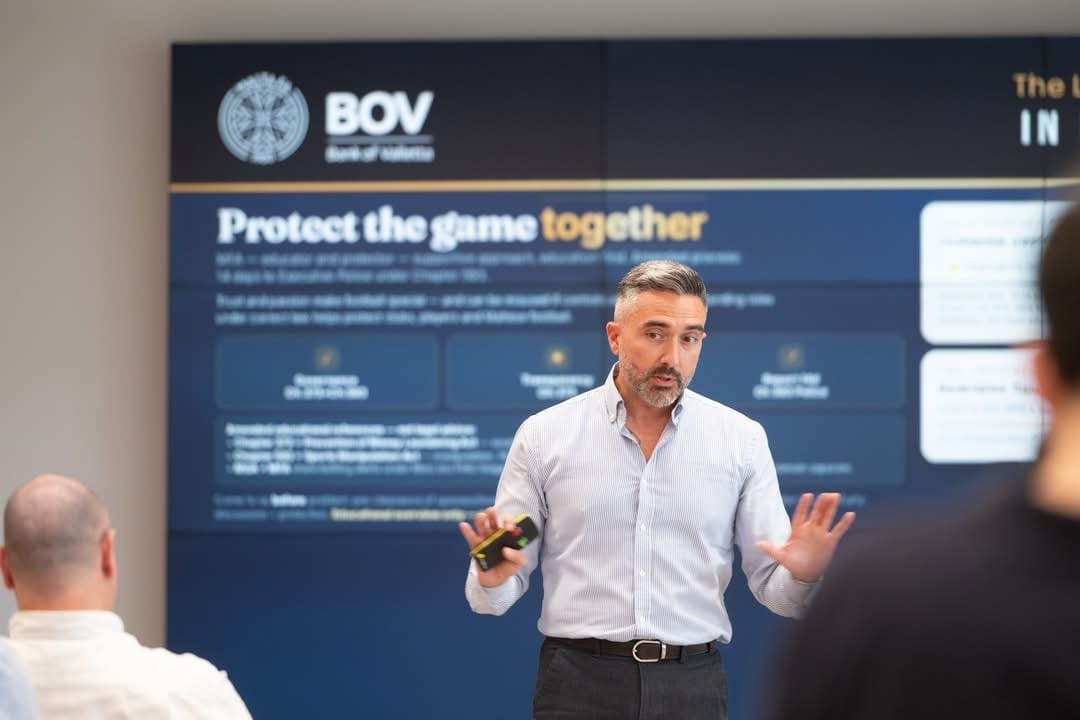
The Malta Football Association and Bank of Valletta plc recently hosted “The Legal and Financial Crime Landscape in Football”, a timely forum bringing together club officials and stakeholders to examine the evolving legal, regulatory and financial crime landscape affecting football.
The event addressed a broad range of issues, including BEC and sponsorship fraud, sanctions, AMLD6/AMLR, beneficial ownership and governance obligations, highlighting the increasing regulatory scrutiny surrounding the football sector and the importance of effective compliance frameworks.

The event also featured Dr Herman Mula, Founder of HM Advocates and Integrity Officer / Prosecutor and Head of Legal Services at the Malta Football Association, who delivered the final topical session, “Integrity, Match Fixing & Money Laundering Risks.”
The session examined the increasingly significant intersection between sporting integrity and financial crime, focusing on four key areas:
- Understanding match-fixing risks
- Money laundering through football structures
- Recognising red flags and warning signs
- Reporting and escalation mechanisms
Match-Fixing and Money Laundering
Match-fixing cannot be viewed solely as a sporting violation. It may also intersect with broader financial crime risks and, in certain circumstances, provide a vehicle through which illicit financial flows can be generated, transferred or concealed.
As football has developed into a complex commercial environment involving clubs, sponsorships, player transfers, intermediaries and numerous financial relationships, the sector faces vulnerabilities that require effective oversight and appropriate controls.
The presentation highlighted the importance of understanding the correlation between match-fixing, financial flows and money laundering risks, drawing on practical experience within football integrity, legal and prosecutorial frameworks.
Recognising these risks requires stakeholders to look beyond the sporting dimension and consider the financial structures, transactions and relationships that may sit behind potentially compromised activities.
Recognising Red Flags and Strengthening Reporting Mechanisms
Effective integrity and financial crime prevention depend, in part, on the ability to identify warning signs at an early stage.
Unusual financial transactions, unexplained sources of funds, suspicious sponsorship arrangements, conflicts of interest, irregular betting activity and other anomalies may warrant further scrutiny and, where appropriate, escalation through established reporting channels.
For football clubs and organisations, this reinforces the importance of robust governance structures, compliance procedures, internal controls and reporting mechanisms.
Integrity and Compliance: A Shared Responsibility
The discussions at the event underscored that protecting the integrity of football is a shared responsibility.
Clubs, governing bodies, regulators, professional advisers and law enforcement authorities all have an important role to play in strengthening governance, financial sustainability and integrity within the football ecosystem.
The session reflected the increasingly important relationship between sporting integrity, legal compliance and financial crime prevention.
As football continues to operate within an increasingly sophisticated regulatory and financial environment, understanding the risks — and having the appropriate mechanisms to identify, report and address them — is essential to protecting the integrity and sustainability of the game.
Events such as “The Legal and Financial Crime Landscape in Football” provide an important platform for this dialogue, bringing together stakeholders to share knowledge, identify emerging risks and strengthen the frameworks designed to protect football.